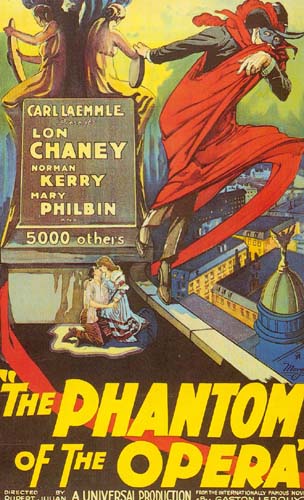
"THE PHANTOM OF THE OPERA is an ultra fantastic melodrama, an ambitious production in which there is much to marvel at in the scenic effects...Lon Chaney impersonates the Phantom. It is a role suited to his liking, and one which he handles with a certain skill, a little exaggerated at times, but none the less compelling...The most dramatic touch is where Christine in the cellar abode is listening to the masked Phantom as he plays the organ. Then she steals up behind him and...suddenly snatches the mask from the Phantom's face...In the theatre last night a woman behind us stifled a scream when this happened."---The New York Times
Released September 6, 1925 by Universal as their latest "Super-Jewel" production, The Phantom of the Opera is undoubtedly star Lon Cheney's most famous role. It has inspired five remakes, dozens of take-offs, and a very successful Andrew Lloyd Weber musical. The film is considered by many historians as one of the greatest of all time.
Despite the accolades of modern critics, PHANTOM was a movie that almost never got made, as it was plagued from the start by production problems. Director Rupert Julian proved terribly difficult to work with, and the script went through numerous rewrites before and during production. Unconfirmed rumors have it that Chaney directed some scenes while Julian was storming around the set.
After shooting was completed, the picture was previewed in Los Angeles in January, 1925. The original storyline followed Gaston Leroux's 1910 novel fairly closely. Chaney's masked title character, also known as Erik, haunts the Paris opera house, offering young singer Christine Daae‚ (Mary Philbin) encouragement as a mysterious voice emanating from her dressing-room walls. Erik finally whisks Christine away to his lair in the catacombs, where, in a scene that is still quite startling, she unmasks him, revealing his disfigurement. Christine briefly escapes and returns to her more conventional lover, Raoul (Norman Kerry), before she is kidnapped once again by the unhinged Erik, who, when confronted with her love for Raoul, releases her and dies.
The audience didn't go for the ending, and the preview left them, and producer Carl Laemmle dissatisfied -- so the film was extensively reworked before being screened in San Francisco, where it again proved unsatisfactory.
The film premiered in its "final" version on September 6, 1925 and achieved a tremendous popular success. Most of the new changes were omitted, except for a new, climactic ending directed by Edward Sedgwick and shot by Virgil Miller, ASC. The film cost over $600,000 by the time the final print was previewed. The expense was worth it, however -- as PHANTOM would go on to earn over $2 Million in revenues -- one of the largest figures for any silent film.
Adding to the film's incredible atomosphere, were impressive full-scale sets of the Paris Opera House and the catacombs, some of which, according to some sources, are still standing at Universal's Soundstage 28. Though largely black & white, several sequences were originally shot in an early two-color Technicolor process, and others were manually colored using a complicated "Handschiegl process". The costumes were beyond lavish, and Chaney's make-up is truly a cinematic feat -- the secrets of which, he took to grave with him.
"The story has been produced on a stupendous scale. Among the sets are those representing the interior of the famed Opera House...and they are said to be authentic in every detail. This effect has also been enhanced by presenting many of the scenes in natural color...Obviously the title role was one for Lon Chaney and he gives a superb performance. Here was another chance to distinguish himself as an unrivaled artist in character make-up and he has done just that." ---Moving Picture World
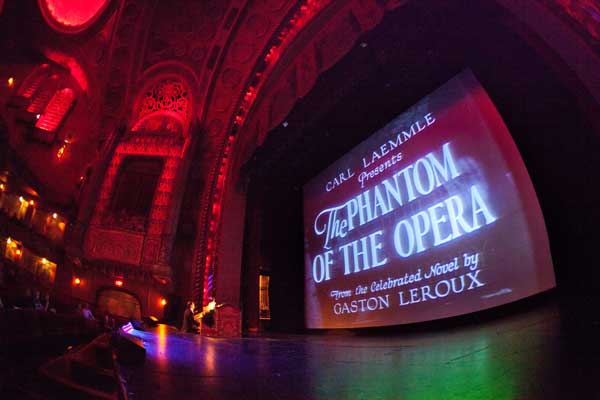
The original musical score for PHANTOM has been lost to history. Our performance of PHANTOM includes an original score written for the film, by organist Tom Helms, which he will perform live on the Mighty Wurlitzer.
Credits: Director: Rupert Julian (with uncredited parts by Lon Chaney and Edward Sedgewick); Screenplay: Elliott Clawson, from the novel by Gaston Leroux, with additional writing by James Spearing, Bernard McConville, and Robert Schrock; Cinematography: Charles Van Enger, Milton Bridenbecker, and Virgil Miller; Assistant Directors: Robert Ross and Joseph Pasternak; Art Director: Ben Carr‚ (unbilled); Color Photography Supervision: Edward Estabrook; Set Design: E. E. Sheeley and Sidney Ullman; Set Construction: Archie Hall.